
A few past projects
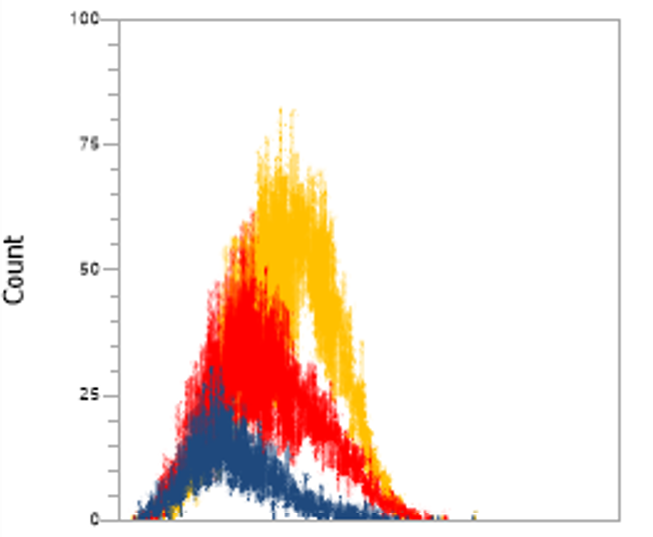
Cell line improvement
Challenge: a client's specialty cell line was underperforming; a mixed clonal population that was insufficiently homogeneous and, on average, expressed too little of the marker gene to be useful.
Approach: we performed terminal dilution cloning to isolate single-cell clones, followed by expansion, stability validation, and quantitative marker expression analysis by FACS. The main technical hurdle was maintaining cell viability through the dilution, selection, passaging, and expansion steps.
Outcome: Several stable monoclonal isolates, each with distinct, reproducible marker expression at a different level, giving the client a tunable panel of validated lines for downstream work. Project concluded in 3.5 months.
Deep target research
Challenge: A client needed feasibility assessment of a tripartite extracellular receptor complex as an antibody target. Proprietary antibody sequences were available, but their epitopes were unknown, leaving open whether the antibodies engaged the complex in a therapeutically productive way.
Approach: We combined computational and experimental work into a single integrated package:
Deep literature and patent analysis of the target and surrounding biology
Co-folded structural models of the receptor complex, exploring several plausible architectures
Traditional and AI-assisted docking of the client antibodies against receptor structures and models
Recombinant expression of antibodies and individual receptor components
Full reconstitution of the receptor complex - which required transient ligand-mediated stabilization
Fab fragment generation and affinity measurement by SPR
Production of selectively biotinylated reagents at quantities sufficient for the client to continue work in-house
Outcome: The client received a complete reagent package: biotinylated receptor components (5-30 mg each), fully reconstituted complex (3 mg), full-length antibodies (10 mg each), and purified Fab fragments (8 mg each), together with a comprehensive research report synthesizing the literature and patent landscape and proposing three strategic options for advancing this target toward an mAb therapeutic. Project concluded in 5 months.
Evolution of cell line under selection
(three generational snapshots shown)
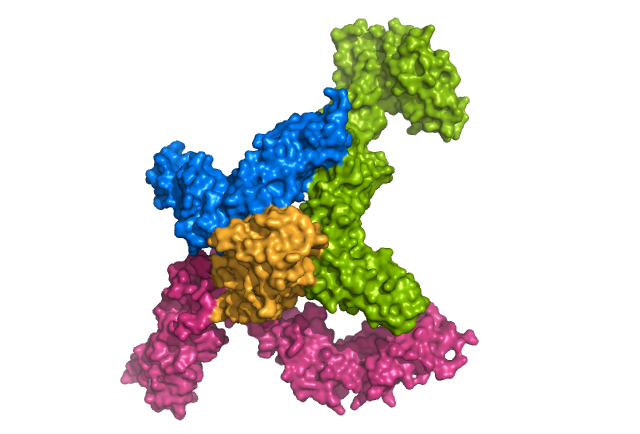
Heterotrimeric receptor with ligand
(homologous structure from RCSB)
Challenging assay development
Challenge: A client needed to convert a complex biochemical assay into a validated, HTS-friendly format. Their large-CRO HTS partner was ready to run the screen but unable to adapt the existing assay because the original protocol required a custom protein substrate (commercially unavailable), followed by proteolysis, chemical fragmentation in hot acid, and HPLC analysis of a liberated prosthetic group. This was too complicated and variable to run without adaptation and improvement.
Approach: Following a comprehensive literature and patent review, we proposed a conversion strategy that the client reviewed and approved. We then designed, sourced, and tested a fluorescent analog of the critical reaction component - eliminating the plate-to-plate transfers, acid treatment, and proteolysis steps in a single substitution. The redesigned assay was validated on our in-house Biomek liquid handler prior to handoff.
Outcome: In 4 months*, the client received a robotics-ready protocol, a full QC package (Z’ > 0.75), the synthesis route and remaining supply of the custom reagent, and supporting documentation for their HTS CRO. The subsequent commercial HTS campaign yielded progressable hits.
*Please note that 2 months of the 4 was due to waiting on custom reagent to be produced.
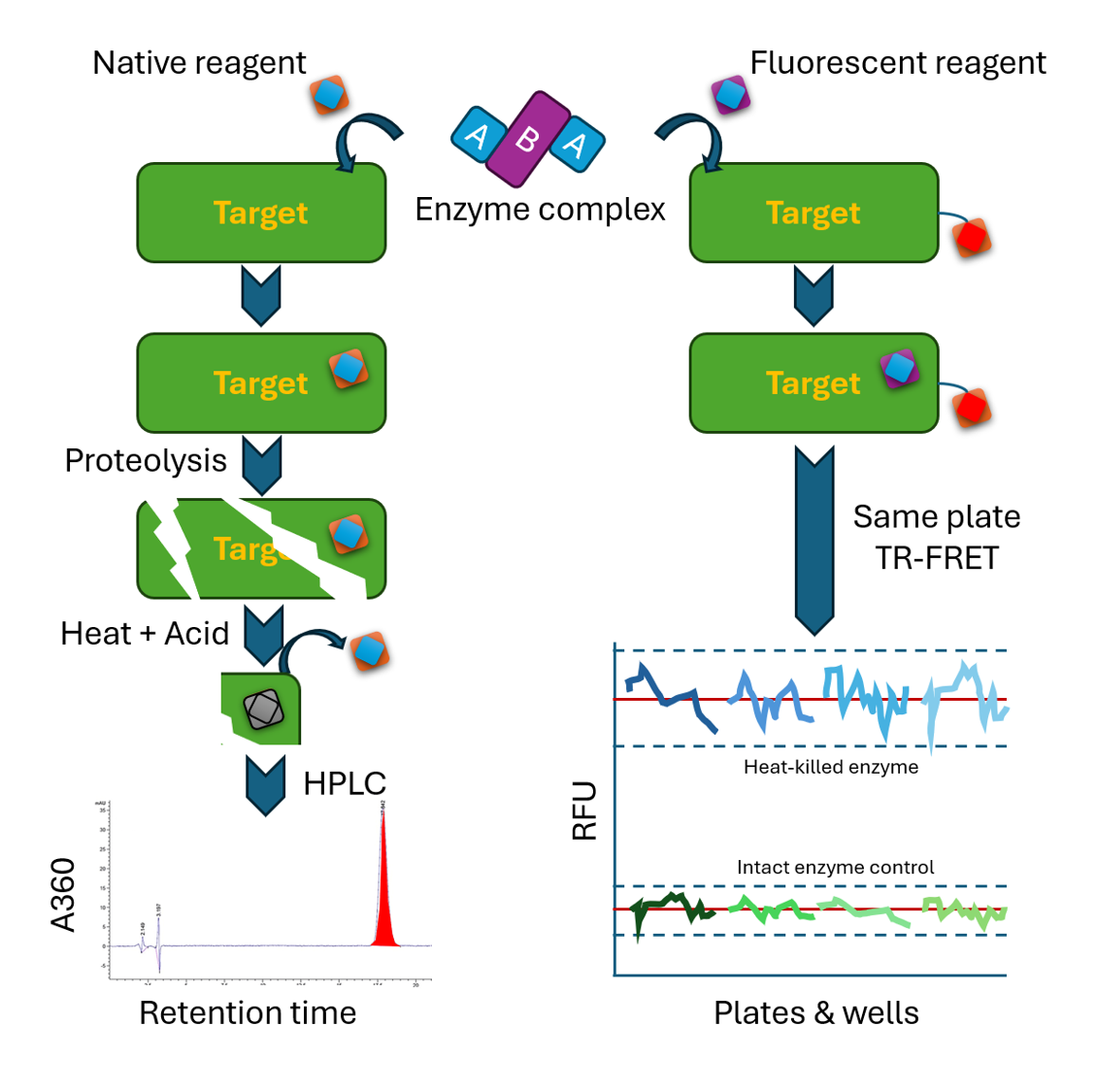
Original assay (left) has too many steps and plate changes.
Improved assay (right) is single-pot